Make Your Own Flower Essences: A Personal, Complementary Practice
Updated: Jul 22

Flower Essences as a Complementary Practice
Flower essences are a complementary, non-invasive practice that some people use for emotional reflection and support. In my own work, I approach them as a symbolic and experiential form of plant-based care, rather than as a medical or psychological treatment.
Flower essences are discussed here as a complementary, symbolic practice within integrative mental health.
You can read more about my overall integrative mental health approach here.
They are often chosen by individuals with sensitive nervous systems who are drawn to gentle, non-activating practices.
Plant-based preparations exist along a wide spectrum. Herbs and essential oils interact with the body through their physical constituents, while flower essences are traditionally understood as working on a more subtle, emotional level.
Rather than acting through concentrated plant chemistry, flower essences are approached as carrying the imprint or quality of a plant—similar to how the presence, sight, or scent of a flower can evoke a particular emotional response.
Making flower essences is a simple procedure. But it requires mindful presence from the practitioner. Mindfully walk thought your garden and be sensitive to the feelings that come up as you allow yourself to bathe in nature’s presence.
Historically, flower essences were developed within homeopathic and holistic traditions, most notably by Dr. Edward Bach. Today, they continue to be used within integrative frameworks as a symbolic support for emotional themes and life transitions, often alongside other forms of care.
How to Make Your Own Flower Essences
I use commercially prepared flower essences from established sources, and at times I’m also drawn to make my own. Working directly with plants—observing them, preparing remedies slowly, and spending time outdoors—is deeply calming for me. In this article, I share a simple way to make your own flower essences, not as a prescription, but as a personal, reflective practice that you may find therapeutic and grounding as well.
Let the flowers call to you. I’ve been drawn to irises throughout my lifetime. Iris flower essence nurtures individuals who need to work on a soul level and want to bring passionate creativity to their life’s work. I watched my irises and waited until the plant had alot of blooms. Some people like to harvest their flowers for making essences only at the full moon. The full moon often coincides with abundant bloom.
Let the flowers call to you. I’ve been drawn to irises for as long as I can remember, watching them emerge each year with their gorgeous depth of color.
Across cultures, the iris has often symbolized communication, creativity, and the bridge between inner experience and outer expression. The iris' upright form and unfolding petals suggest movement between worlds - earth and sky, thought and feeling, inspiration and form. When working with an iris flower essence, I hold these symbolic qualities lightly, allowing them to inform personal reflection rather than dictate meaning.
When making an essence, I spend time with the plant and wait until it feels ready—often when the iris is in generous bloom. Some people prefer to harvest flowers during the full moon, which frequently coincides with this abundance. For me, the timing is less about lunar rules and more about attunement: noticing when the plant feels most vibrant and when the moment invites stillness, care, and presence.

I cut the flowers early in the morning, on a sunny day, when I knew the sun would be strong. I wanted to use the sunlight to capture this particular iris essence. People like to use the moonlight or the sunlight to manifest flower essences. Without touching the water or the blooms with my fingers, I clipped the flowers off and let them fall into a bowl of spring water
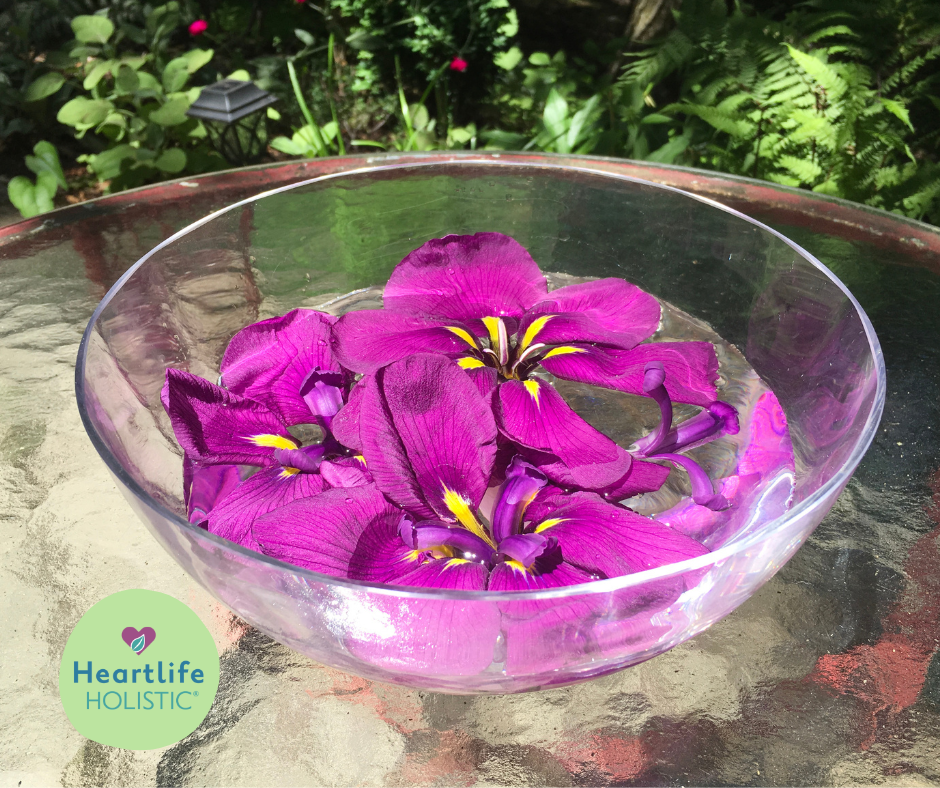
Then I let the flowers sit until the essence had imprinted in the water, about 2 – 4 hours in the sun.

After about 4 hours, using a sanitized tweezer, without touching the water with my fingers, I removed the blooms. The water that is left holds the iris flower essence. I had pre-sanitized ten small dosage bottles to hold the flower essence. I added a 1/4 teaspoon of vodka as a preservative, then about just about filled bottles with spring water, then dropped ten drops of the essence into each dosage bottle. Now I have my own iris essence, filled with the energy of my garden!
Final Thoughts
Making your own flower essences can be approached as a quiet, attentive practice rather than a technique to master. Whether or not you work with flower essences regularly, spending time with plants in this way invites slowing down, observation, and care.
For me, the process itself—being outdoors, noticing subtle changes, and working with intention—has been deeply restorative.
If you choose to try making your own essence, let it be an experience of presence and relationship with the natural world, taken at your own pace and in a way that feels respectful and nourishing.