
Bead Your Story: An Expressive Art Practice for Birth Trauma and Nervous System Healing

Updated: Feb 19

When the Birth Story Lives in the Body
A traumatic birth can be physically and emotionally devastating. Social support for those going through trauma treatment and for long-term survivors of trauma can improve quality of life, reducing anger, anxiety and depression. This practice supports a Mind-Body approach to healing that supports nervous system regulation.
Research increasingly shows that feeling unheard or unsupported during childbirth can shape long-term emotional wellbeing.
Art therapy projects can help express feelings of sadness and reduce the feelings of loneliness. A wonderful art therapy project for a support group for birth trauma survivors is called “Bead Your Story”.
The transition into motherhood — often described as matrescence — can intensify the emotional impact of a difficult birth.
Practices that support nervous system regulation — including mindfulness and gentle sensory exercises — can help the body feel safe again.
This exercise is a nice way to break the ice in a support group, or to cheer people up after they have gotten to know each other in a support group.
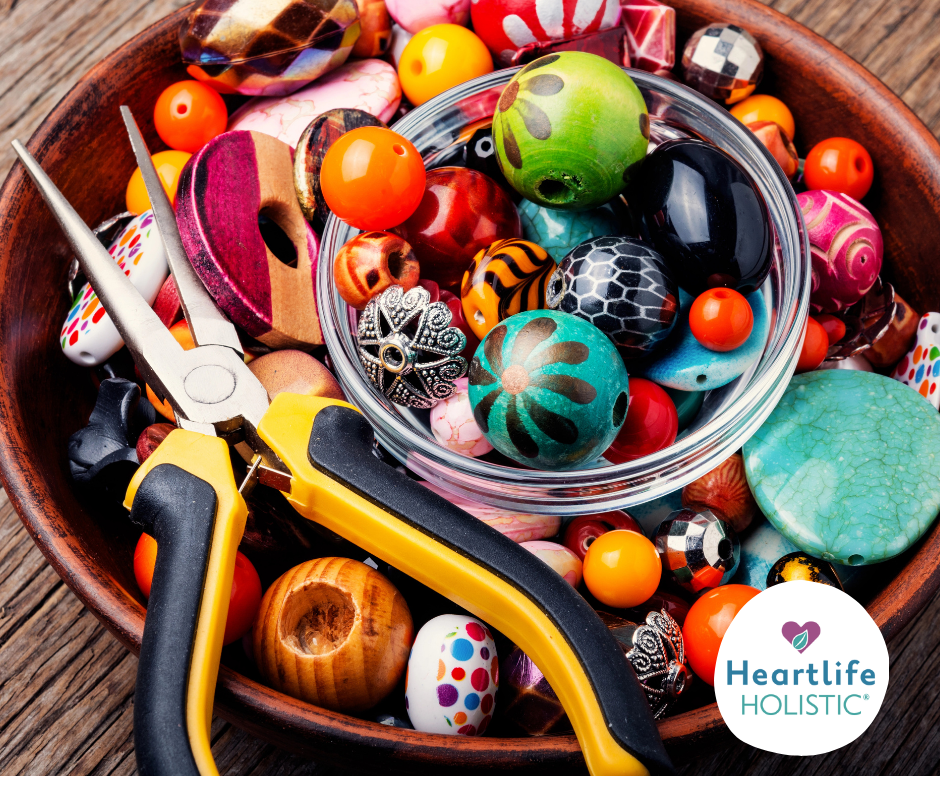
The materials you will need are some brightly colored beads and materials to string for a necklace, bracelet or keychain.
For this project, choose red, green and blue, and some other complimentary colors of your choosing. Use the bigger wooden beads for this project so you can talk and bead at the same time. You can make either a bracelet, a key chain or a necklace. For the necklace, purchase waxed beading string, for the bracelet, purchase elastic string and for the key chain purchase a a plain round key ring and add waxed beading string to it, on which to string the beads.

Bead Your Story: Emotion and Meaning in Color
Above is an example of one of the participant’s necklaces.
Begin your expressive beading project by deciding if you want to make a keychain, bracelet, or necklace using the beads you have purchased. As you bead your project, please share the parts of your personal story of that you wish to share and also share your hopes.
The Psychology of Color and Symbolism
As part of your design, you can use different color beads to express different meanings to share with the other members of the group.
Green Bead – Your Pregnancy
As you handle and string your green beads, let the green beads symbolize your thoughts, feelings and experiences surrounding your pregnancy. Please share this with your group.
Red Bead – Your Birth
As you handle and string your red beads, let the red beads symbolize your thoughts, feelings, and experiences surrounding your experiences about the birth. Perhaps there were times you felt supported, yet other times when you did not feel supported. Please share your experiences with your group.
Blue Bead – Your Hope
As you handle and string your blue beads, let the blue beads symbolize hope. Reflect on who, what and how you build and sustain hope, and how you keep living your life to its fullest. Please share this with your group.
The Psychology of Color
Some interesting color anecdotes
Green is an emotionally restful color. It symbolizes life, rebirth, abundance, renewal and health. Its connotations are harmony, balance, and forward movement. In Chinese medicine, green is associated with the Wood Element, the season of Spring, and the yin/yang energy of the emotions of balanced growth versus frustration and anger.
Red is an emotionally intense color. Its connotations are emergency, danger, caution, and the extreme emotions of passion, conflict, hate, and love. It has been shown to have a stimulating effect, raising respiration rate and the heartbeat. In Chinese medicine, red is associated with the Fire Element, the season of Summer, and the yin/yang energy of the emotions of isolation versus intimacy.
Blue is an emotionally calming color. Its connotations are confidence, stability, intelligence, unity, and steadfastness. In Chinese medicine, blue is associated with the Water Element, the season of Winter, and the yin/yang energy of the emotions of fear versus confidence.
If you are processing a difficult birth experience and would like professional support, you can learn more about trauma-informed perinatal therapy at my Psychology Today page.


